Cooling options for homes on the Northern Beaches: Expert’s guide
As energy costs rise, many Northern Beaches homeowners start by trying to keep the house cool without relying on an air conditioner all day. Ceiling fans run longer, blinds stay closed, and windows are opened late at night to catch a temperature drop. For a while, that can work.
Then you hit a stretch of humid nights. The warm air hangs around, hot air builds up inside, and bedrooms stop feeling comfortable. That is usually when people start comparing what actually helps long-term, not just what feels better for an hour.
In this blog, our air conditioning experts break down what genuinely works in Northern Beaches homes, where fans and passive cooling help, and when air conditioning becomes the more practical option.
If you are considering air conditioning installation on the Northern Beaches, Ozcon Air Solutions can provide clear, practical advice. Call 1300 341 694 or submit an enquiry.
Why does cooling feel harder in Northern Beaches summers
Coastal conditions change the way a home cools down. Humidity reduces the cooling effect you normally get from air flowing across the skin. Sea breezes can help, but they are inconsistent, especially after dark. Many homes also store heat in walls and roofing, so indoor temperatures stay higher even when it feels cooler outside.
This is why “quick fixes” often stop working here, particularly when you are trying to cool a room overnight. It also ties in with the broader issue of heat affecting rest and day-to-day functioning.
Related Article: How summer heat impacts sleep, health and productivity on the Northern Beaches.
Fans: a low-cost way to feel cooler
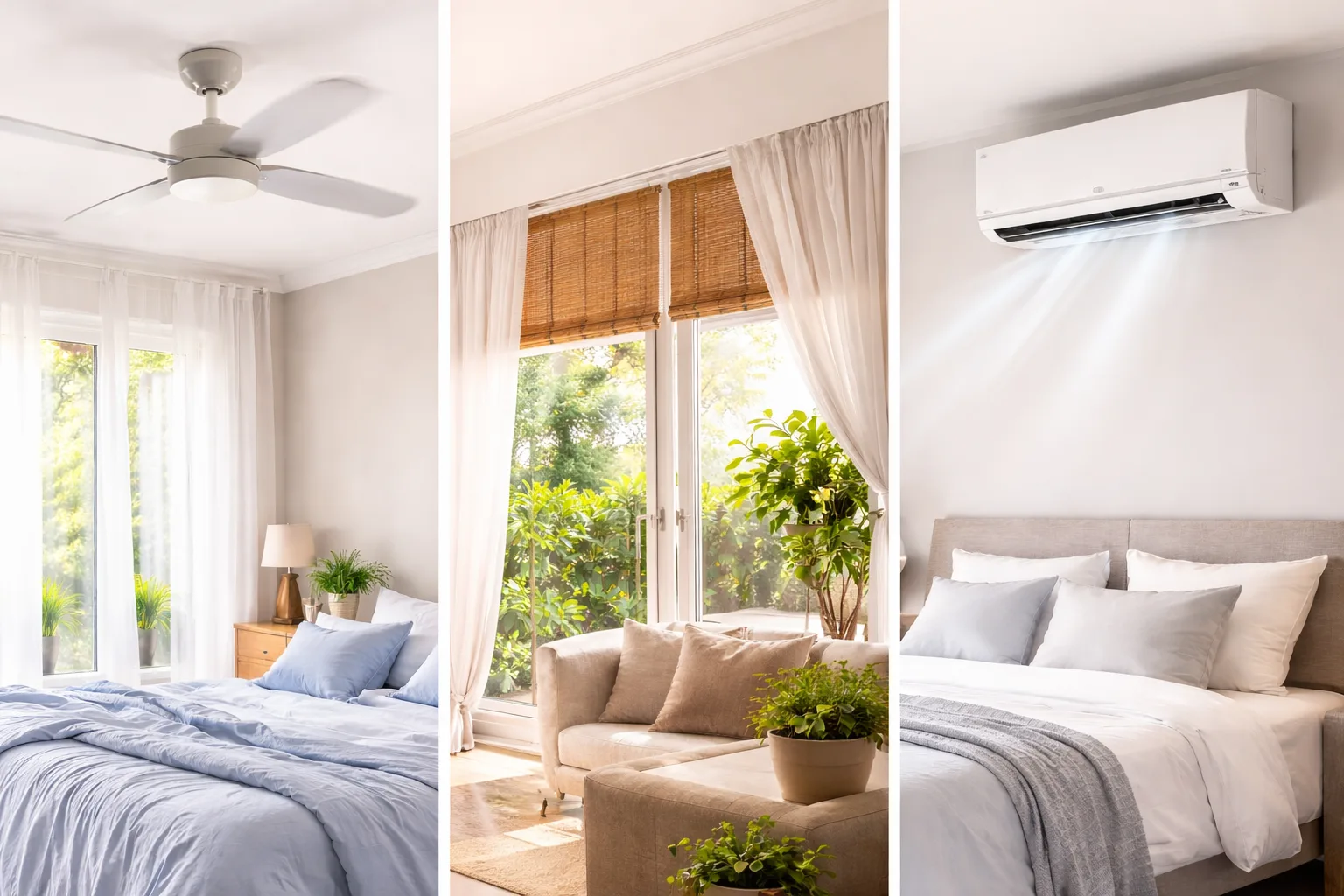
Fans are often the easiest option when working out how to keep a room cool in summer, especially if you are trying to keep running costs down. They do not lower the room temperature, but they can make you feel cooler by improving air flow and helping sweat evaporate.
A few things people miss with fans:
- Ceiling fans usually feel better than small portable units because they move more air across a wider space.
- Portable air conditioners and fans solve different problems. A fan moves air. A portable air conditioner actually removes heat, but it can be less energy efficient than a fixed system in many cases.
- Fans work best when the air is already reasonably cool. When the room stays warm and humid, the comfort improvement is limited.
Fans can still play a role even if you use air conditioning, because circulating cool air helps rooms feel more even. That can allow a higher thermostat setting, which supports better cost-effectiveness in summer.
Passive cooling: keeping heat out in the first place
Passive cooling is about reducing the amount of heat that enters the home, so you need less mechanical cooling later. It is often the cheapest way to improve comfort because it reduces the amount of hot air the house retains.
Practical passive steps that often help in Northern Beaches homes include:
- Shading windows that get afternoon sun
- Improving sealing so cool air stays in longer
- Insulation that reduces heat transfer through ceilings and walls
- Using ventilation at the right time, such as late evening when the temperature drops
These measures can make a house feel more stable, but they are not always enough through a run of humid nights.
That is usually when people start weighing up a proper heating and cooling system rather than relying on windows and fans alone.
Evaporative coolers: where they fit, and where they don’t
Evaporative coolers can be effective in low-humidity climates because they cool by evaporating water. In more humid conditions, they generally become less efficient because the air already contains more moisture.
In coastal areas, the practical issue is that evaporative coolers can add moisture to indoor air. For some homes, that can become uncomfortable and may create other issues over time if the home is already holding humidity.
For Northern Beaches households, this is often why evaporative coolers are considered, but not always chosen as the main solution.
Air conditioning: the most reliable option when nights stay warm
When fans and passive design reach their limit, installing an air conditioning system becomes the most reliable way to cool a room because it actively removes heat and can help manage humidity.
Common options include:
Split systems
Split system air conditioning is a popular choice for bedrooms and living spaces because they deliver targeted cooling with good control. When selected correctly, they can be energy efficient and relatively quiet for overnight use.
If budgeting is part of the decision, it helps to understand what drives split-system air conditioning costs on the Northern Beaches.
Ducted systems
Ducted air conditioning is usually chosen when you want whole-home comfort or multiple bedrooms cooled at once. Zoning can help reduce running costs by cooling only the rooms you are using.
Portable air conditioners
Portable air conditioners can be useful for renters or temporary situations, but they are often less efficient than fixed split systems, and they can be noisier in bedrooms.
When comparing models, look at the Zoned Energy Rating Label and choose the most suitable energy rating for your climate zone. In general, more stars mean higher efficiency and lower running costs for similar-sized units.
What people usually miss when choosing cooling options
Most cooling choices are made based on daytime comfort. Night-time use is different. The wrong setup can leave you with a system that technically works, but still does not feel right in a bedroom.
Common issues include:
- Wrong sizing leading to frequent cycling, noise, or poor humidity control
- Airflow aimed at the bed, causing drafts instead of steady comfort
- Inconsistent temperatures across rooms if the system does not match how the home is used
- Efficiency is overlooked by not checking the energy rating label before buying
Cost uncertainty often delays decisions. Many households hesitate because they are unsure what is reasonable or necessary. That uncertainty can lead to putting things off until comfort drops further and the solution becomes more expensive or urgent.
How to decide what to do in your home
If your goal is to keep your home cool without overusing power, a combined approach often works best:
- Use passive measures to reduce the heat coming in
- Use fans to improve comfort and distribute cool air
- Use air conditioning when heat and humidity make other options unreliable
The risk of choosing poorly is spending money and still feeling uncomfortable, especially overnight. That usually leads to replacing equipment earlier than expected, or running systems harder than necessary.
Need advice on air conditioning?
If you are weighing up cooling options and you are leaning toward air conditioning, it helps to get the system type and sizing right from the start.
For local guidance and installation support, call Ozcon Air Solutions on 1300 341 694 or submit an enquiry for clear, practical advice on the best air conditioning setup for your home.